सोमवार, 12 अगस्त 2024

MANIFESTATION & CELEBRATION OF ‘SAAVAN’ IN INDIAN LIFE


(Painting of Kalidas writing Meghdootam)

“ The season of rain approaches , my love , like a king,

his royal cavalcade in full ceremonial procession,

dark clouds- his war elephants in their rutting season,

glowing flashes of lightning -his tapering victory flag,

and roaring thunder- the sound of beating war drums

welcomed by the crowd of lovers with maddening cheers.”

                              ( Ritusamhara-Canto 2/1, - Kalidas, translation-Abhay K)


The season of ‘Saavan’ ( monsoon) is not only critical for the economic sustenance of the country but for emotional sustenance too. In India, it is awaited and celebrated across the length and breadth of the country . It purifies and rejuvenates us both physically and emotionally. It is an embodiment of new life . The barren and dry surroundings which were  eager and anxious for new lease of life are blessed with running streams uncontrollable and overloaded rivers , rushing and gushing falls . Man suffers too but never does he cease to celebrate . He consoles himself by attributing the cause of his loss to the natural law of the above and almighty .

This celebration is more pronounced in rural India which is steeped in tradition and culture , but the urban India too does not lag behind and with the advent of digital revolution ceremonies and celebrations are uniform , far and  wide. In addition   to the various rituals which are observed during the season the urban young, converge to Lonavala and Khandala like destinations to witness the dramatic change of dull and grey surroundings into lush and green . In many towns and cities the  young arrange and attend the ‘Monsoon Ball’ , ‘Raindance’ etc. The sight of the sea on the  west coast beaches  is riotous. The ever rising waves, the roaring sound , the muddy colour exhibits the ‘Roudra Roop’ .And yet; there is beauty in this display  as it is a facet of its character, unseen in other seasons . It is a ‘cultural festival’ in which the Man and Nature participate . It is a celebration of life. These manifestations and celebrations are in abundance in Indian Literature , dance,  music , festivals and rituals. Music conferences  and ‘Malhar festivals’ are organised in colleges. The ‘Malhar festival’ of St Xavier’s college Mumbai is very old and famous.


                                                          (Painting of Tansen singing Malhar)

 Though technically the month of ‘Saavan’ is from ‘mid -July to mid -August’ , but in common parlance the ‘Varsha Ritu’  (Rainy season) which falls between ‘mid - July to mid-August’ is referred to as ‘Saavan’ and in some cases such as  16 Saavan Somvaar vrats’ it extends further. The word ‘Saavan’ emanates from the Sanskrit word – ‘Shravan’ meaning to listen. During earlier times the sages would retreat from their forest abode and reside with prosperous patrons  during the rainy  season. They would sermonise, relate stories and  teach scriptures to their devotees . Therefore the act of listening closely and attentively is ‘Shravan’. This tradition in some degrees is being maintained as ‘Ramayan Katha’, ‘Ramcharitmanas’ are organised by rich devotees and invitations to neighbours are extended. Well reputed sages would elaborate upon the richness of   the epics over  extended periods.  Individual and collective ‘paaths’ (  loud rendition ) of ‘Sundar Kaand’ ( a Section of ‘Ramcharitmanas’ ) is also very popular.

 Some festivals have all India celebrations and some are at local and regional level. Lord Shiva is the principal deity of ‘Saavan’ . ‘Saavan Somvaar vrat’  is observed mostly by women  in many parts of India.  Young women observe 16 ‘Saavan Somvaar vrats’ to be blessed with a good husband.  In addition to observation of fast on Mondays of ‘Shrvan/Saavan’ period; many devotees organise ‘Rudra- Abhishek’  with ‘Rudri Paath’ which is considered very auspicious and fruitful during this time.  Ardent Devotees known as ‘Kaanwarias’ would travel on foot to distance Ganga river in Haridwar and bring ‘Ganga Jal’ to offer to ‘Shivji’ in local and individual shrines.  The famous ‘Amarnath Yatra’ , a Shiv shrine in Kashmir is also conducted during this season . Since this is the season of mating and progression among animals fishermen do not venture into sea and only commence their profession after ‘Narali Poornima ’ in August.

  The festival of 'Teej'( the third day) is special to women and is observed in many parts. However,   it is celebrated with much participation in UP and Rajasthan.  Devi ‘Parvati’ is worshipped as ‘Teej Mata’ and in Rajasthan a procession of ‘Teej Mata is taken out. It is known by various names-‘Teej’, Hariyali Teej’, ‘Hartalika Teej’, and ‘Kajri Teej.  Women  wear colourful attire , adorn  ornaments and  Chudis ( glass bangles), apply ‘mehndi’( Henna) , sing, dance and play on the swing with their friends and relatives. ‘Kajri’ ‘Jhoola’ and ‘Saavan’ songs are  sung and swings are fixed to the trees , general festivities prevail and good food is served . In some places childless women observe ‘Nirjal’ ( without water) fast.


                                                         (women celebrating 'Teej' festival)

  The festival of 'Rakshabandhan' is celebrated on ‘Shravan Poornima’ and is considered as one of the most auspicious days in Hindu calendar . On this day during present times the sisters tie 'rakhi' ( Raksha bandhan) of colourful silk or cotton material  to the wrist of their brothers to seek their protection and receive gifts and blessings, “ ab ke baras bhej bhayya ko Babul Saavan mein lejo  bulaye re.” (Shailendra- Film Bandini .) filmed on a female convict in jail is depiction of the solemnity of the day  and longing to be Home . Once restricted to North and West India gradually it has assumed wider acceptance on account of it’s simplicity and emotional appeal. However during earlier times ‘Rakshabandhan’  was primarily a ‘Brahmin’ festival during which Brahmin priests and other Brahmins as well would be privileged to tie the ‘Raksha Bandhan’   to the wrist of their ‘Yajmaan’ ( client ) and people of other caste and community and receive a token amount as gift. It is recorded that Akbar and Jahangir would permit their ‘Raj Purohit’ to tie  the sacred thread to their wrist , perhaps as symbol of respect for the custom! The original name of the festival was ‘Solono’ meaning the ‘new year’ in Persian . It was end of old and beginning of new  Fasli season’ ( harvest season).


Some states have their own festivals in accordance with their tradition . The festival of ‘Harela’ in Uttarakhand is celebrated to praise and rejoice with nature . People plant saplings , women dress up in green saris and sing traditional  ‘Harela songs’  sow seeds and worship ‘Shiv Parvati’ .

  Kerala’s famous ‘Onam’ festival also  falls during the rainy season and people from all communities celebrate by decorating their Homes with flowers and ‘Rangoli’ , dress well in traditional attire , wear ornaments , make special ‘Onam Saadya’ ( food) and meet and greet each other. It is believed that King ‘Bali’ visits his subjects on this day and therefore people across religion , caste and community participate on this occasion.

The festival of ‘All India’ character , ‘Janmashtami’  ( birthday of Lord Krishna) is  also observed during ‘Varsha Ritu’ in various manners. In Mumbai it is called ‘Gokul Ashtami’ or ‘Dahi Handi’ . During the day various groups of young enthusiasts would attempt  by making human pyramid to break ‘Dahi Handis’ fixed high across the road  all over  the city containing curd and money . They would be in colourful attire and practice for the event . However; The eternal image of the festival is ‘ new born Krishna’ being carried by his father Vasudev in a basket on his head  under heavy rains and river  Yamuna in full spate on account of monsoons.

 Classical Music accords  exclusive treatment to  ‘Saavan’. There are numerous ‘Raags’ attributed to this season- ‘Malhar’, ‘ Megh Malhar’ , ‘Miyaan’ ( Tansen) ki  Malhar’  , ‘Raag Megh’ . Semi classical offerings such as ‘Kajri’( sung during monsoon in eastern UP ), Jhula ( sung during the festival of Teej which falls during Saavan ). Popular ‘Saavan’ songs have been sung by Jagjit Singh and Shubha Mudgal such as the electrifying music video’ Ab ke Saavan…ruth saavan ki’ and ‘Soun da mahena aaya’. The treasure house though is with the legendary classical singers such as Girija Devi ( savan jhar  laagi dhire dhire..) , Rasoolan Bai (tarsat jiyra hamaar nahiyar..bit gayi re barkha bahar), Shobha Gurtu ( sawan ki rut aayi re sajaniya),Pandit Channu Lal Mishra and many more who have given an ocean of ‘Saavan ‘ music to survive us for long. Ustaaad Bismillah Khan has played ‘Kajri’ and other ‘Saavan’ songs , being from Varanasi he was immersed in classical as well as folk tradition.

However; since the arrival of cinema , it is the ‘Hindi film music’ which has been inspired by the season of ‘Saavan’ most and there are large number of songs and situations and ‘titles’ of films celebrating ‘Saavan’. Numerous songs and scenes have been filmed  expressing the feelings of the people during the ' Saavan ' season. The core theme is of love and longing ! Three overlapping emotions are observed to be generated through the various songs  through the ages in 'Hindi Cinema' . First; there is longing for one's love , second; there is kindling of passion; 'Agni' and desire to meet one's lover, third;  hope  that the long lost /long forgotten lover would  return home. Interestingly this voice is mostly expressed by women and in some cases by seemingly introvert and conservative girls/women. As the earth gets drenched with the advent of rain and expresses by way of  greenery and harvest, the human desire and response is similar. Commencing from the film 'Devdas' starring  K L Sehgal  in the title role in 1935 "Balam  Aye   Baso   mere   man mein , Saavan   Aye   Tum  na  Aye” to the landmark 1949 film ‘Barsaat’ by Raj Kapoor and the title song  Barsaat mein  hun se mile tum sajan tumse mele hum” to 2001 ‘Lagaan’- “ Ghanan Ghanan Ghira aye badra”. The songs covey – hope, joy and wish fulfilment. In the intervening years there is a large body of work on the subject.

 In Bimal Roy’s ‘Do Bigha Zameen’ of 1953 the farmers celebrate the arrival of ‘Saavan’ by this song written by Shailendra : 


                                             (Farmers are happy as rain arrives: film  Do beegha zameen)


“ Haryala  Saavan dhol bajata aaya

Dhin tak tak man ke more nachata aaya

Mitti mein jaan jagata aaya

Dharti pehni hai hari chunariya

Banke Dulhaniya

Ek agan bujhi , ek agan lagi

Man magan hua

Ek lagan lagi

Are ya ye ye yaa”

( The  green Saavan has arrived beating the drums( sound of clouds) , my mind is dancing like peacock. The ‘ Man ka More’ imagery used above emerges in many ‘Saavan’ songs and s convey kindling of desire. It has activated life on soil. The earth is wearing a green attire like a bride. One hunger is quenched ( arrival of rain) and another activated ( passion). My mind is busy in love.)

Perhaps the most popular ‘Saavan’ song among couples is from the 1979 film  ‘Manzil’ starring Amitabh Bachhan and Moushmi Chatterjee , composed by Yogesh and sung by  both Kishore  and Lata :

“ Rim zhim  gire Saavan , sulag sulag jaye man

Bhige aaj is Mausam mein lagi kaise ye agan “


(  The Saavan rains have aroused passions, in this wet season what sort of desires have been kindled?)

Another song representative of rural India and our composite culture is from the film ‘Junoon’ sung by  Asha Bhonsle.  It consists of numerous Saavan symbols and images- dark clouds, Bela and Chameli flowers, mehndi, Jhula( swing), Glass bangles, green chunariya, lightening. The song was composed by  the scholar and Awadh culture expert Yogesh Praveen :


“ Ghir aayi  kari ghata matwari, Saavan ki aayi bahar

Bela Chameli ki kaliyan chatakgayin ,Mehkat ban ki bayar


Khil gaye hatheli pe mehndi ke bute , Lachkat Jhulan se daar re

Dhani chunar more sar par ne thehere, Chudiyan kare jhankaar


Angna mein bhiji atariya pe bhiji, Bhiji sajanwa ki sej re

Bheej gayi mori hai kori chunariya, Rimzhim ras ki phuhar”


(  the wayward dark clouds have set in , the pleasant days of Saavan have arrived . The buds of Chameli and Bela flowers have bent , there is fragrance in the wind  from the jungle .

The flower designs of mehndi  have emerged on hands , the branch hanging ‘Swing’ is bent . The green ‘Stole’ ( chunariya) is moving away from my head; the glass bangles are making sound.

I got wet in courtyard and rooftop, my lover’s bed also got wet

My spotless ‘stole’ ( thin cloth material )also got wet in the falling rain.)


      (Devanand & Waheeda Rehman in Kala Bazaar-'Rimzhim ke tarane leke aayi barsaat’)

  Literature of India contains poetry and prose   work in praise and celebration of ‘Saavan’ . Urdu poetry too has many poets write on the theme of ‘Saavan’ / ‘ Baarish’ etc . Apart from recording the dramatic changes  in nature the movement and colour and expression of the clouds , the flowers and the green fields filled with paddy , the joy of animals – Cuckoo, Peacock, Papiha, frog and others . It captures the happiness of the people – Jhula ( swing) , Mehndi , glass bangles etc. The most profound literary work and statement on the rainy season is witnessed in the literary work of ‘Kalidas’ – great Sanskrit writer of 4th century A D . His ‘Meghdoot’ and ‘Ritusamhara  are  full of detailed imagery of the ‘Rainy Season’ and  how the earth ,men-women , animals , flowers respond to the rain and clouds.

However the classical composition of Kalidas is ‘Meghdoot’ . As the name suggests it means ‘cloud messenger’. It relates in vivid and sparkling manner the story of ‘Yaksha’ who is exiled for a year by ’Kuber’  for negligence in duty . He misses his wife terribly and asks the ‘Monsoon Cloud’  to visit ‘Alkapuri’ in Kailash . This poetic work was written in 4th Century A D about 20 centuries back  shows the richness and beauty of the India’s Golden age and the depth    of the ‘Sanskrit’ language. It sows the seeds of ‘Saavan’ /’Varsha Ritu’ representation and celebrations in Indian literature and society. The presence of a large number of its translations confirms its appeal and beauty. In ancient times  ‘Darshan’( sighting)  of an Elephant was considered very auspicious.  Kalidas therefore writes that when Yaksha sights a ‘cloud’ on a distant hill top on the  first  day of ‘Ashadha’ month  it was  like  of an elephant in a playful mood :   

“ ..on the first day of the month of Ashadha ,

he saw a cloud embracing

the mountaintop, like an elephant bent down low,

playfully butting his brow” ( stanza 2, ‘Meghadutam by Kalidas, translation, Shrinivas Reddy)


Mira Bai celebrates ‘Saavan’ in her Bhajans:

“ Ghir aayi ri badariya Saavan ki

Saavan ki man bhavan ki

Saavan mein umangya mero manva

Bhinak sunat Hari aavan ki”


Here the great saint poet and ‘Krishna Bhakt’ Mira Bai is writing in 16th century . She says that  the  ‘Saavan’ clouds have  set and are very pleasing. That she was very excited and could sense the arrival of   Shri Krishna .


Suryakant Tripathi ‘Nirala’ has written many poems titled ‘Badal Raag’ in celebration of the rainy season ,:

            …baar baar Garjan , varshan hai moosladhar

               Hridaya thaam leta sansaar , sun sun ghor vajra hunkaar

        ….rog shok mein bhi hansta hai , sheshav ka sukumaar sharir

           …jeern bahu hai , sheern sharir, tuzhe bulata krishak adhir..”

 (the sound of clouds, the pounding  rain , the fearful sound . But,  children (sheshav)  in ill health    too are  happy. The frail farmer is also calling the rains)


      (Chatak bird which drinks only rain water)

Mir Taqi Mir , the famous 18th century Urdu poet has written on ‘Barsaat’:

  “ rut hai barssat ki bahut pyari, mouzazan jhilene nadiyan saari

Khet dhaanon lehlahe shadaab , kar rahen hein nazar ki dildari

…saundi saundi zameen ki mitti , bhini bhini chaman ki boo pyari..

… Kokila bagula koyelen taoos , apni taanen sunate hain pyari” 


( the season of rain is so pleasing , the overflowing lakes and rivers .

The paddy fields full and green, are so attractive to eyes

There is the smell of earth from first rain and the fragrance from the garden.

The cuckoo, crane and peacock are singing full throated so sweet)


Kalidas  grants benediction and sums up the essence of the season in the stanza below:


“ May this season of rains, full of delights,

stealing hearts of amorous women, a formless

friend of trees, creepers and shrubs, and the life spirit

of all living beings grant your deepest desires!”

                 ( Ritusamhara-Canto 2/28, translation - Abhay K )

बुधवार, 31 जुलाई 2024

PREMCHAND : THE PEOPLE'S WRITER


With age and experience, observation and assimilation we consider certain artistes, writers, leaders as close to our own ideology. Our own ideology to a large extent is influenced by these people, whom we consider as our own ; almost sacred. We refer to them from time to time, verify our opinions and defend their ideas and actions in  discussions and debates often at the cost of annoying our family and friends. They  remain in one corner of our consciousness , well guarded by us as our  support for sustenance and survival.

  There are few of them; whom I have idolised over the years, Munshi Premchand ( 1880-1936) is one of them. His birth anniversary falls on 31July . A few days back  I was  again reading his most famous short story ‘Idgah’, which tells the story of a four year old boy ‘Hamid’ who spends the only three paise he had for ‘Iid’ celebration to purchase a ‘chimta’ ( metal tong ) for his grandmother ‘Amina’ to ensure her hands and fingers remain safe from fire while making ‘chappatis’ , whilst his other friends purchase expensive toys he sacrifices his desires and even defends bravely his purchase. The grandmother is so moved by his gesture that she weeps uncontrollably showering blessings on the lad thus becoming childlike in front of the small boy who for that moment becomes her guardian. It is  a poignant story, which is one of the best and representative work of Premchand. Innocence of childhood, child psychology, games children play! The atmosphere during ‘Iid’, the village setup all are depicted so minutely and accurately in the short story .Prem Chand was a keen observer of Society. He wrote for the victims of socio-economic oppression. Not all his stories were serious, even then there was an undercurrent of humour in his style .

 Born  in Lamahi village near Varanasi he learnt Persian and Urdu under the tutorship of the village Moulvi. His mother loved him immensely and died when he was only eight . This affected him lifelong and his characters are often those who have lost their mother in young age . The motherless child would play and roam the village with friends and was on the verge of being wayward but was saved by his interest in reading . From the age of thirteen he would read thick volumes of Urdu literature of Maulana Faizi , Mirza Rusva, Pandit Ratan Nath Sharshar ( Afsana-e- Azaad)  and Urdu translation of ‘Purans’ published by  Navalkishore Press Lucknow. Rest he imbibed by direct observation of society. No great human influences other than his mother were in his life. No influential politician or religious or social reformer carved his ideas other than some novelists . Gandhi made a big impact on him but that influence was on the entire Nation.


The topics of his  journalistic writings too dealt with local, National and International issues and on  varied and interesting subjects - ‘Oliver Cromwell’, ‘Laila -Majnu’, ‘Reporting on Nehru’s speeches’, ‘Maxim Gorky’ ,’Hindu-Muslim issues’, ‘peasant problems’, ‘untouchability’, ‘ freedom movement’, ‘ book reviews ’etc. Most of these writings appear in the monthly Urdu magazine ‘Zamana’ from Kanpur belonging to Munshi Daya Narayan Nigam with whom he developed a life long friendship and wrote a column titled ‘Raftare Zamana’  . He also wrote for other newspapers and magazines. His journalistic writings are compiled in three volumes by his son Amrit Rai titled ‘Vibhinn Prasang’ ( various subjects). There are also two volumes of his letters titled ‘Chitthi Patri’.

  He was fortunate enough to see popularity and fame in his life time but prosperity eluded him. His many short stories and novels were first published in newspapers and magazines , the rise and role of Hindi/Urdu press contributed to his fame. .   In his dying months too he would be writing to complete his novel ‘ Mangal sutra’ in order to succeed financially for the family . He ‘Presided’ the first ‘Progressive writers’ conference’ in 1936 organised in Lucknow by Sazzad Zahir which  speaks of his stature. His address stands as a ‘Historical document’  . A paragraph is illustrated here: 

“Literature which does not awaken our interest, which does not give us spiritual and mental  satisfaction , which does not give us strength and   vitality , in which our love of beauty is not kindled , which does not give us  resolve to overcome our difficulties is useless for us today. It does not qualify to be called Literature....... those writers who follow the rich  ; follow their style of writing and those who belong to the masses write in the language of the masses”

In his letter written in English to Mr Indra Nath Madan   dated  16 December 1934 he expressed his opinion and information on number of points which he was asked.  Rangbhoomi’ was his favourite Novel  . His characters  were ‘ideal characters’ with human failings. He was influenced by the writings of Leo Tolstoy, Victor Hugo and  Romain Rolland. The writings of Ravindranath Tagore impressed him, but he evolved his own style. He did not write ‘Drama’ as the value of  it was in staging and at that time quality of stage was not good . He was not impressed with  the ‘Parsi Theatre’ . He considered Novel writing as vehicle of conveying his thoughts and was aggrieved that Indians did not buy books and therefore financial independence for writers was difficult. He was very disillusioned with the cinema world and the compromises one had to make and was to leave it soon. He believed in the evolutionary change in the society and not revolutionary. He did believe in ‘Supreme deity’ but stated that it hand no hand in ‘human affairs’ . Regarding marital life he said that one has to ‘compromise’ , any of the partner has to bend.

Once he was asked about the high points in his life. He said that his life journey was straight and plain with no ‘Highs’ perhaps ,  many ‘pitfalls’ on path. 

After his death his name and fame moved leaps and bounds . His books by numerous publishers were available in all book stores. A look at Railway station ‘book stalls’ would confirm his appeal among readers   . His stories and novels are taught in schools, colleges and Universities and writings are translated in many languages. However his journalistic writings and letters need more publication and publicity to understand the depth of the person.

   Lifelong  he was resolving the ‘three major conflicts and challenges in his life’ and died at relatively young age of 56. The first was his health and constant ‘stomach ailment’ on account of  which he struggled and suffered.  The second was his financial condition which bogged him down till the end. He was first a school teacher  and supported his family and stepmother . In order to supplement his income he would regularly write in newspapers and magazines . He plunged into ‘non cooperation movement’ in 1921 on the call of Gandhiji and sacrificed his pension . As owner of printing press and publication ‘Hans’ and ‘Jagran’  he was in constant debt. He tried his luck  in cinema writing and stayed as writer of a production house in Mumbai for a year and despite good pay left out of dissatisfaction . He wrote dialogues for a film titled ‘Mazdoor’  which were so powerful that crowds came out in the streets and the administration had to stop screening.  The third conflict was his fight for justice and freedom of the down trodden and oppressed through his writings in which he was victorious and  is remembered .

Premchand’s  writings have not been fully explored in cinema in a way his Bengali peer Sharat Chandra has been . His novels ‘Gaudan’ and ‘Gaban’ were  made into films many years back and some TV serials have not done justice . Only Satyajit Ray made the remarkable film ‘Shatranj ke khiladi’  . Perhaps a film maker of Ray’s calibre only may bring out the essence of  Premchand on Screen

Firaq Gorakhpuri  has written an Essay on him in his ‘Garden of Essays’ where he writes , “ His voice was a new voice in Indian Literature . He made children and grown up people thoughtful and moved them emotionally by his stories. He brought literature from isolated circles to the life and labours of the Indian people . India was presented in the sincerest and most living way in his writings. About 50 years ago the work done in one Indian language was not known to the readers of other Indian languages. Premchand’s work broke down these barriers. He became along with very few great writers an all India figure in Indian literature.” 


I return to him regularly to refresh and rejuvenate myself. Each of his story is material for research on subjects such as sociology ,  history,  psychology and  more. Such is the greatness of Premchand who resides in my sacred corner; secured.


मंगलवार, 9 जुलाई 2024

THREE FRIENDS UNDER ONE ROOF


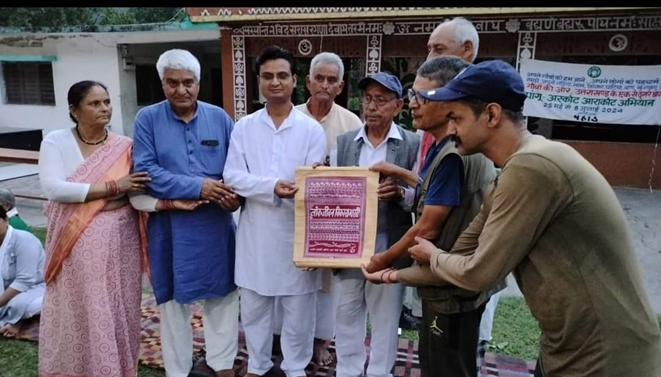
The 6th  ‘Askot to Aarkot’ expedition has concluded on 08 July at Aarkot, Uttarkashi adjoining Himanchal Pradesh. The expedition motivated by Late Sundarlal Bahuguna was started in 1974 on 25 May coinciding with birth anniversary of the great freedom fighter Shridev Suman who died in Tehri prison in 1944 after being on ‘hunger strike’ for 84 days.

   Since 1974 this Yatra has been repeated after every 10 years and this was the 6th edition and the golden jubilee year . The Yatra  conducted by various groups on various routes in order to cover maximum villages and ground ,under the banner of 'Pahad' an NGO and being led by Dr Shekhar Pathak . The purpose was to know the hills and its people . to have a two way communication with them. To assess progress made during the period.

  Numerous stories of interaction with the villagers emerged and related by the group members. One such story is very interesting and moving. It is from ‘Budha Kedar’ a village in the district Tehri Garhwal of Uttarakhand , the place is famous for its Shiv Temple which has the biggest ‘Shiv Linga’ in north India so it is believed. It is also a trekking area . When a group of ‘Askot-Aarkot’  expedition reached this village  they were welcomed by them and they knew of their expedition as the village had hosted previous members . During the conversation they learnt that three friends belonging to three different castes chose to stay together under one roof and share the common kitchen for 12 years . What is noteworthy was  that in villages caste consideration and caste hierarchy are well defined and practiced still . But these three friends had developed a bond during their schooling together and were also part of the ‘Sarvodaya’   movement which had reached this remote village in late forties after Independence.

  In 1950 when the Nation was celebrating its first Republic day three friends- Dharmanand Nautiyal  a Brahmin , Bahadur Singh Rana a Kshatriya and Bharpura Nagwan a Shilpkar   moved together in one house with family and children . The house still stands there as proof of their unique experiment and symbolism. They stayed together and earned their livelihood together . Many people opposed their move but they withstood their ground ,some were appreciative but in subdued voices. The social awareness imbibed by the three in ‘Gram Swaraj’ movement of Sarvodaya had made the friends ideologically strong. For their livelihood Nautiyal had his shop in the village , Rana had his land to till and Nagwan was employed in village for various masonry work.

 This bold step was taken after an initial experiment. Nautiyal had his shop in which as per practice and tradition he kept three ‘Hukkas’ for the three different castes . He removed two and just kept one and observed the response . The favourable response motivated the  friends to take the revolutionary step. They together built a three storey house . They would also organise combined feasts for all castes together , the home had become a symbol of progress and development, not only social but economic development . When they parted amicably as friends they remained friends .

 The group visited the house where the friends had stayed and son of Nautiyal Shri Dhirendra Prasad Nautiyal was present. This is an inspiring story in such times when class , community and caste considerations are even sharper. The Nation wide caste census is the demand of many political parties.

 This story appeared in ‘Avikal Uttarakhand’ a digital platform and was written by Arun Kuksal.

I felt so proud of my State after reading this story  because I know that in any other village in India this was not possible and even if the friends   had attempted they would have been thrown out of the village.

Perhaps this was a dream of Mahatma Gandhi when he talked and wrote of 'Village Republic'.


रविवार, 7 जुलाई 2024

SHEKHAR PATHAK LEADS 6TH ASKOT – AARKOT EXPEDITION


                           Shekhar Pathak


The famous lines of the  poet ‘Iqbal’ from his ‘Tarana e Hind’ come to mind and sound so ‘ironical’ as time has come for us to protect the ‘Himalayas’! The Mighty Mountains which have beckoned Adi Shankaracharya, Swami Vivekanand, numerous saints, scientists, colonists, activists and commoners are inseparable part of our existence and identity :

     Parbat wo  sabse  ooncha

       Humsaya  Aasman  ka

       Wo  Santari  Hamara

       Wo  Paasban   Hamara”

    ( Mountain so high

     So that it meets the sky!

    It is our Sentry!

   It is our protector!)

     Shekhar Pathak, historian , environmentalist , founding editor of the annual journal ‘Pahad’ (since 1983) , is leading and guiding the ‘6th Askot to Arkot expedition’  in the Uttarakhand hills . Askot is at the east end  of the state in Pithoragarh district adjoining Nepal and Aarkot is at the west end in Uttarkashi district adjoining Himanchal Pradesh. A distance of about 1150 km is being covered in about 45 days from 25 May to 08 July 2024.

    The first  ‘Askot-Aarkot expedition’  started in 1974 on 25 May on the birthday of Shridev Suman the  great freedom fighter of Tehri Garhwal who died in jail in 1944 after observing 84 days of hunger strike. The motivation of Yatra  was accorded by  late Sundar Lal Bahuguna, one of the prominent   leaders of the ‘Chipko movement’ . The students of the newly opened Garhwal and Kumaon Universities participated . Since then expeditions have been undertaken after every 10 years . The expedition motto is:

                                          Apne gaavon ko hum jaane

                                              Apne logon ko pehchane.

                                             Talon , gallon – bugyalon ke sang

                                             Apni nadiyon ko bhi samzhen.’  

                                           ( we shall know our villages 

                                                   understand  our people

                                            along with lakes, glaciers, alpine pasture lands

                                            Also assess our rivers )

Therefore the objectives are to know the people and the environment. What is creditable is that this contact and study programme which commenced in 1974   shall be completing 50 years in 2024! Many members of the of the expedition would have covered these villages  and people earlier too.

   Over the years other organizations and  students from various universities joined the expedition and other mountain states were also explored . The year 2014 expedition was flagged off by Shri Chandi Prasad Bhatt another great leader of Chipko movement for which he was honoured with  Magsaysay award. He  named the expedition –‘ Jangam Vishwavidyalaya’. Research students from America , Canada , Germany and eight Indian states were part of the team of about 200 personnel.

 This year  the theme is – ‘ Strot se sangam’ ( from source to confluence) concentrating on rivers of Uttarakhand. Other subjects of study include- destruction  caused by mining, dam construction , road construction , the state of Dalit and minority communities , socio – political awareness, economic and cultural interventions, the increase in migration, the changes  which have occurred in villages. Two way communication is conducted, it is a learning experience for the team members too  . The state shall be completing 25 years shortly and the team would delve in  the aspects of progress in these  years.

  This year the group consists of workers of various organizations, students from universities from all over India, students from colleges of Uttarakhand and Himanchal Pradesh , journalists , writers, artists, scientists, social scientists , socio- political workers, other Himalayan lovers of the country. Expedition shall be undertaken by various groups embarking on various routes.

           In order to make the expedition more purposeful some  historical routes undertaken by ancient and modern travellers  have been added such as that of Huen Swing’s 7th century Travel. Some routes of Pandit Nain Singh Rawat’s famous expedition and that of Swami Vivekanand have also been included.


The expedition shall cross 7 districts of Uttarakhand- Pithoragarh, Bageshwar,  , Chamoli, Rudra Prayag, Tehri Garhwal, Uttarkashi and Dehradun.

The journey shall cover 350 villages, 35 rivers, 16 ‘Bugyals’ ( alpine pastures),  15 earthquake and landslide affected areas , 15 Chattis (deserted resting/shelter stations ), 8 areas of Chipko movement, 5 tribal areas, 5 pilgrim routes, 3 Indo- Tibetan routes and shall commence from Pangu-Aarkot  in Pithoragarh and  culminate at Askot in district Uttarkashi. At the end of the journey participants shall be sharing their experiences and a conference is being planned

   What is the significance of this expedition in addition to above, specially for the young citizens? In times when the tourists flock to hills during summer in their motor cars and clog the roads and Hotels , it is motivation for the young to move on foot . The tradition of making journey on foot was prevalent in hills since ages by pilgrims from near and far. The char-Dham yatra which is so popular from May to November is now undertaken by road on motor  vehicles . But, once there was a regular walking route from Rishikesh to Kedarnath and Badrinath and pilgrims moved on foot for months on the designated route. The same needs to be revived by the tourism department in order to instil the  true spirit of the devotional  journey, adventure , contact with people . It is encouraging to learn that  this ‘ancient route’ was rediscovered by Lokesh Ohri ,Anthropologist and cultural activist based in Dehradun  and his team and they covered the 438 km route in 10 days in January 2016, rediscovering many chattis ( resting places)and caves for shelter  on the way. The same was reported in ‘Times of India Dehradun’  of 19 February 2016. The report also laments that the mistakes brought out after the Kedarnath disaster of 2013 have not been adhered to and still construction is being done along the road and bridges are being constructed where avoidable. 

     Shri Jai Singh Rawat  senior journalist of Uttarakhand has brought out  in his article  titled  ‘Dhare reh gaye Kedarnath aapda ke sabak’ ( lessons of Kedarnath tragedy left aside) published in Hindi ‘Daily Tribune’ 0n 18 June 2024 that up-to 16 June in mere one month and six days of ‘Chardham Yatra’ 2,58,957  vehicles reached ‘Gau mukh’ near by glaciers, ‘Badri -Kedar’  and ‘Yamnotri’ which causes  melting of glaciers and increase in  mountain lake areas and numbers  . The total tourists in the four shrines reached to 23,54,440 up-to 16 June whereas up-to the year 2000 in six months also less tourists visited.   Jai Singh states that according to recent assessment of   ISRO  among 147 landslide sensitive areas  districts ‘Rudra Prayag and ‘Tehri’ of Uttarakhand   are at no 1 and 2 position respectively and all 13 districts of Uttarakhand are in the list .


Traditionally when people undertook the long and arduous  pilgrimage the journey which entailed extended stays at holy stations was purposeful . Understanding the local culture and receiving the sermons by reputed saints was an important purpose. Some families and elders liked the weather and people so much that they settled in Uttarakhand. Even today the ‘Amarnath’ Yatra and the last leg of Kedarnath yatra is undertaken on foot.

      It was reported that on  23 June 2024,  about 3000 people gathered near new Cantt road Dehradun to protest against Administrations plan to fell 250 trees in order to broaden the road . Citizens were concerned about the rising temperature up-to 40 degrees in Dehradun . It seems that an ‘Urban Chipko Movement’ was  not far! Ram Chandra Guha , historian , writer and environmentalist has stated in his article titled ‘ Local to Global’ in 09 Sep 23 ‘Telegraph’ that compared to Ooty hills Uttarakhand hills have more challenges on account of the annual ‘Chardham’  yatra, border security related infrastructure  and the Hydro electric projects. He writes,“ I have deep personal attachments to Garhwal and to the Nilgiris . I would therefore wish for a ‘bioculturally sustainable future for both these hill stations . Yet, on the available evidence , it seems that the prospects for such a future for Garhwal are close to non -existent” 

     Uttarakhand is a small but sensitive State with respect to National security, water, electricity, religious tourism. The Mighty Himalayan peaks, the gushing rivers , the scenic beauty, numerous  holy shrines,  have been a  source of  emotional sustenance  for the Nation. Therefore in these times ,  Shekhar Pathak  stands as a  true soldier, scholar and leader and inspiration. His expedition is  a reminder for us all to shed life of comfort and contribute by example.

   It is appropriate to end the article by quoting from the ‘Information letter’ promulgated by  Shekhar Pathak regarding the expedition in which he quotes in Sanskrit from  Aitareya Brahman( 3/1/3)’ , which translates as follows:

 The fate of the sitting person is   sitting

The fate of the standing  person is  standing

The fate of the sleeping person is sleeping

The fate of the travelling person  , is on the move!

Therefore; keep travelling!”


                                                Shekhar Pathak with a group at Panwali Bugyal


गुरुवार, 25 जनवरी 2024

Bobby at 50 : A Tribute


Bobby at 50: A Tribute 
Raj Sahab; thank you for liberating us) 

‘Bobby’ a film on Teenage love story released in 1973 liberated the Middle class India ; the bulk of the film goers. It freed us from the clutches of our parental controls as the college crowd clapped, wept and cried watching Rishi Kapoor and Dimple, meeting, shying, loving, separating, fighting, cajoling, contesting, escaping, eloping, dancing, defying as their story unfolded on the screen. It reflected the sub - conscious desire of us all, our parents, grand parents, teachers and the masses. Raj Kapoor gave us a film which we had not even seen among the Hollywood cinema to which we were exposed.  'Summer of 42' did explore briefly this teenage desire to be together and the protagonist in it also did get liberated by the young widow whose husband had died in the ongoing world War. But it was Bobby which was near us and brought the colors and music for us on screen. The film lifted the Taboo . The commercial success of the film transformed the theme and story. A simple teenage love story written by the Marxist film maker and writer Khwaja Ahmad Abbas who had earlier written 'Awaara', 'Shree 420', 'Mera Naam Joker' for Raj Kapoor. It was a love story of a Boy of rich parents who do not have time for him and on account of his naughtiness is banished to boarding school . On his return to Home there is a grand party thrown by his parents in which his Nanny arrives uninvited to give him a cake. She is accompanied by her granddaughter ‘Bobby’ played by Dimple Kapadia. On seeing her Raj played by Rishi Kapoor falls in love with her, though they do not meet but he sings a song in the party" Main Shayar to nahin , magar ai haseen jab se dekha maine tumko ; mujhko shayri aagayi... ". Raj wants to meet her and visits his Nanny. They meet, fall in love, but the rich and poor conflict arises which after heart aches and adventures are overcome. They finally live together happily. Prior to Bobby there were many love stories about students. But the role of the students was played by elders and aged actors -Rajendra Kumar, Sunil Dutt, Manoj Kumar, Pradeep Kumar etc. With 'Bobby' it was perhaps the first time when the age of lead actors was realistic ( though Rishi was 21 at the time of release but he looked a teenager), Dimple was 16. They looked a convincing 'Teenage couple' and acted and sang' Teenage ' - " Hum tum ik kamre main band hon aur chabi kho jaye ". The magic which mesmerized us all was the presentation of the film. It was a love story in which new actors were introduced. It was perhaps the first time when a young love story had 'young lead actors'. Rishi had played a Chubby boy in ' Mera Naam joker' who falls in love with his teacher , but all that was forgotten when he arrived in slim and trim shape and was different and new and most viewers considered him to be a newcomer. Raj made this movie as a ‘bench mark’. Though it is learnt that he was not much hopeful of it's success. He had planned a big dacoit movie starring Dharmendra and Mumtaz titled ' Daud' based on the story of the famous Gujrati writer Abid Surti;but that was not to be. 

He expected ' Bobby' to be a moderate success film as the actors were new and perhaps it was sort of an experiment. Little did this creator knew that he will launch a new era of young love stories, a new norm a new genre in Hindi film cinema. No matter how skeptical and unsure he was of his film's success he controlled each aspect and department with astuteness for which he was known. His famous music director duo of Shankar Jaikishan had delivered their best music before Jaikishan died suddenly. Known not to many Raj Kapoor himself was a gifted musician and music was the core of his cinema. Shankar Jaikishan gave music to most of his films but it was distinctly Raj Kapoor music with most songs written by his favourite Shailendra. He made music sitting on his harmonium in his famous RK cottage with his team consisting of Shankar- Jaikishan, Shailendra, Hasrat Jaipuri, Mukesh and Lata. They made a formidable group which presented great music from Barsaat to Awaara to Shri 420 to Jis desh main Ganga behti hai to Sangam to Mera Naam Joker. In his films the music matched with the film step to step. Music was the soul of his cinema. This was in Bobby too but the voice, the sound the 'sur' of Bobby was different from his films prior and thereafter. ' Bobby' gave s new ‘sound’ a new ‘meter’ matching with the teenage love story . Music was by Laxmikant Pyerelal but after this the duo never gave a similar music in any of their films, the reason was that there was no Raj Kapoor. A new male voice in Shailendra Singh was discover ed. 'Main Shayar to Nahin..... ' Anand Bakshi wrote 5 out of 8 Songs but such new poetry, such newness and novelty was never witnessed there after, though he continued to be hugely successful and prolific. The reason again was Raj Kapoor and his creativity, his control and mediation and mastery. Two songs - ' na maangu sona chandi, na maangu bangla gaadi ye mere kis kaam ke.... ' and ' jhooth bole kawwa kate kale kawwe se dariyo main maike chali jaungi tum dekhte rahiyo' were written by Vithal bhai patel. Another sufi song ' besak mandir masjid to do Bulle shah ye kehta, par pyar bada dil kabhi na todo is mein dilbar reinda..... ' was sung by Chanchal and is credited to Raj Kavi Tulsi. In addition to Shailendra Singh folk singer Chanchal found success and did sing in films there after. The song sung by Chanchal and his words of ' separation and longing' set in Kashmir opened a new style and situation and used thereafter in films such as ' Hero' by Subhash Ghai where the folk singer Reshma sings on the beach ' chaar dina da mela lambi judai'. The two typical Goan/Koli songs ' na mangu... :' and ' jhoot bole' were extremely popular and added value to the film. Altogether along with the young couple the songs too were a great attraction. 

 The songs moved the story . The first song is sung by Rishi Kapoor in the party thrown by his father on his arrival from the boarding school . A ‘Famme –Fatale’ – Aruna Irani a friend of his mother and an easy going person dances to the song “ Mai shayar to nahin magar ae hasin tujhko dekhe jabse maine tabse shayri aagayi” the image of Dimple appears on the screen as she had left the scene with her grandmother in between , but Rishi had chanced upon her and was imagining her as he sang. The second song shows their love developing and acceptance of each other in various situations displaying the coyness and beauty of Dimple ( Bobby) . She is shown playing badminton ,swimming in a swimming suit, and then Rishi showering flowers on her as she is lazily lying in the garden . All the ingredients of a love blooming are presented through this song-“ Muzhe kuch keha hai…muzhe bhi kuch keha hai …pehle tum …pehle tum” . There occurs a misunderstanding between the two when Dimple is taken to a party by Raj and where he meets Aruna Irani. Bobby thinks that Raj was cheating on her and she goes away to Kashmir as part of the college trip . Raj; like a true lover follows her atop a bus and finds her camp and location. He tries to enter her camp but is beaten badly by the guards who think him to be a miscreant. Then the famous ‘haunting’ song of Chanchal is played on screen . Chanchal himself is on screen by the bonfire made by the village peoople/workers and sings this song on Daphli “ beshak mandir masjid todo Bullehshah ye kehta , par pyar bada dil kabhi na todo is men dilbar rehta, jis paddle main tule mohabat usmen chandi nahin todna dholna main nahin bolna ….” ( it says that we may break Masjid or Mandir but never break the heart where your lover resides……..never barter love for silver) . This music this style , these words were something new apart from Shailendra Singh this was the new voice on screen; now I can compare that like Kailesh Kher became famous at that time it was ‘Chanchal’. While the song is being played on screen Dimple in a black attire suitable to the Kashmir weather comes out of her tent , eyes red and swollen and Rishi stands firm at a distance despite the beating received. Their love had crossed yet another hurdle we in audience could gauge. The song and the words make the two lovers long for each other and differences and complaints seem to be forgotten . Bobby is yet to reconcile and whilst on a horse is unable to control it, probably she does it on purpose. Raj is behind and follows her , she is thrown away by the horse and is on the grass when Raj arrives , they yet again express their love for each other and embrace . Raj takes away Dimple from her friends and in the scenic surrounding of Kashmir they sing that naughty and yet highly romantic song , a unique song – “ hum tm ek kamre main band hon aur chabi kho jaye …….”( we two are closed in a room and the key is lost! ) imagining various silly and simple situations of danger and surprise and expecting a reply from the other.( hum tum yunhi jungle se guzren aur sher aajaye? ) – Sher se main kahun wo tumhen chod de muzhe kha jaye…..” Raj somehow convinces his parents to meet Bobby and her Parents- Father and Grand mother. Mr Jack Briganja is a ‘hands on’ fisherman who does good business , loud, robust, proud, large hearted who drinks rum; bottle tucked in his lungi. Raj is happy and goes to the residence of Bobby to announce the good news and to invite them home. There are celebrations at that time in Bobby’s locality; perhaps someone was getting married ! and two Koli /fisherman songs cast in Goan music are played in sequence showing the vibrant culture , deep love between Raj and Bobby and a little lively repartee. As said above the two songs were penned byVithal bhai Patel. “ Na maangu sona chandi na mmangu bangla gaadi ye mere kis kaam ke ; deti hai dil de badle mein dil ke pyar mein sauda nahin” ( I do not ask for Bungalow or car, I do not ask gold or silver , if you want to give, then give your heart in return of my heart; there is no bargain in love ), the song appropriately suited the occasion and the proposal in hand which Raj brings with him . Immediately after the song is completed , Bobby flutters to the dance floor singing “ Jhoot bole kawwa kate kale kawe se dariyo main maike chali jaaungi tum dekhte rahiyo” ( if you tell a lie the black crow bites you , be afraid of him ; I shall go away to my parents and you keep watching! ). Now; this was a sort of reply to his boastful “ na maangu sona chandi…..”. In the song Dimple is draped in traditional 9 yard saree , which is worn by women in Maharashtra. She looks saucy and different. She dances so professionally . She; perhaps was trained so well that she has never danced like this thereafter on screen. This was celebration of love and there was expectation in the air. The couple was hopeful that in the meeting of their parents the matter would be resolved and they would marry soon. But , that was not to be . Jack Briganja ( Prem Nath ) Mrs Briganja his mother ( Durga Khote) and Bobby arrive in the palatial residence of Pran ( Raj’s father) . After the pleasantries Raj is asked to show Bobby around . The two parties are left to discuss the matter. Raj takes Bobby to his room and Raj presents her with a bottle in which a couple are dancing , they play with it; it depicts their happy state . But below there is problem ; Pran offers Jack money in return to keep Bobby away; Jack is insulted and furious ; they rise and leave. Jack shouts for Bobby who rushes with the gift in hand. Jack in his rage throws the bottle on the floor. It breaks ;Bobby sobs ; they leave ; but the image of the dancing couple does not break; they keep dancing. The audience in the hall understood the symbolism. Bobby is taken away from Bombay to Goa on board a ship. As the ship leaves harbor and Raj stands teary eyed on the shore the most soulful and heart stirring song of the film sung by Lata and penned byAnand Bakshi comes on screen in background –“ Ankhiyon ko rehne de ankhiyon ke aas paas , door se dil ki bujhti rahe pyas…..” ( let the eyes remain close to each other , from the distance our heart’s longing shall be satisfied) . Raj’s father plans his marriage to his friends daughter played by Farida Jalal , who is dim witted and plays her role well , there is grand party thrown on the occasion of engagement . Aruna Irani dances again on the occasion and sings the song “ uska luta ghar baar … dil main phansa”. Here again the words of the song reflect the situation in which Raj is engulfed. Raj runs away from home in his motor cycle, a mini ‘Bajaj bike’ which became very popular at that time . The Aruna Irani song being played in the background. On reaching he meets Bobby but his grandmother pulls away Bobby and locks her in a room . She is also successful in locking Raj in a room as she plans to inform his father of his whereabouts and to take him back home. However ; Raj manages to escape from the window of the bathroom and successfully releases Bobby from her captivity. The two ; run away to nowhere in Raj’s bike with the audience gleefully clapping abound. Whilst sitting on the bike and clutching Raj in tight embrace Bobby in a unique and novel expression of love bites the ear of her lover. Oh ! the audience not only approved the act but enjoyed along. This scene among others remained a talking point of the movie. When they run out of fuel they hitch hike on a truck and encounter the famous villain Prem Chopra who appears as Prem Chopra and incessantly slaps the two lovers and stating “ Main hun Prem ; Prem Chopra …”; this was again a new style and despite being of one scene it was remembered for long. The lovers escape his clutches and decide to drown in the river but are saved by their fathers who had been in the look out for them . The parents realize that they were wrong , and the young lovers were united for ever. 

 As I said that as in any good Indian film made for larger public the songs are not only central to the story but move the story and the story and the film is remembered through its songs.What made Bobby unique was also its casting. From main actors to the minor and character artists were cast correctly. Appropriate casting was one among the many qualities which Raj Kapoor possessed . Firstly; he had to present his son and work on his physique ; make him slim and trim from a chubby boy to a lover with him the young girls in the audience should fall in love! And he succeeded in that. Dimple was exotic ; from another world! If one was to describe her in one word , it would be ‘sophisticated’, ‘ class’. In addition she had that Regal beauty. No one had seen such a face before . As parents of Raj , Pran and Sonia Sahni were cast perfect; Pran was a known face and a versatile actor but Sonia was cast because she was beautiful and arrogant as required in character and was indeed a surprise pick. It is learnt that Raj Kapoor had asked Sadhna; the famous heroine for the role of Rishi’s mother but she declined; such was the insight and interest of Raj Kapoor in his films. For the parents of Bobby he cast Duga Khote as her Grandmother she had acted opposite Prithvi Raj Kapoor and was honoured with Dada Saheb Phalke award ; she played the caring and careful Christian Nanny to the T . For the role of Jack her father he cast his brother in Law ,Premnath – strong, robust , hardy , boisterous, who was in retirement after his successful stint as hero in sixties, as a swashbuckling star. His role as the main villain in Vijay Anand’s ‘Johny Mera Naam’ was so successful that he had an excellent return as a villain. Earlier he was seen in Raj Kapoor’s first successful film –Barsaat in 1949 in a parallel role opposite Nimmi and the memorable and eternal love song “ Barsaat main hum se mile tum, tum se mile hum Barsaat main”. In ‘Bobby’ his attire of Lungi , Koli topi and bandi was apt. when he goes to meet the parents of Raj , he has his own dignity , he carries his own Rum and wears an ill fitted suit like a good Christian going to Sunday Church. He has few scenes- the first is the introduction scene when he arrives on beach after his fishing sortie, the second was his introduction to Raj who has come home to ask Bobby out. The third is the famous scene when he is invited by Pran and pleads and weeps and in the end walks out to safeguard his self respect. The last is when he saves Raj from drowning. The villain in Prem Chopra his single dialogue made history. Aruna Irani in a flirtatious role , played her best role. Farida Jalal as a dim witted , doll like girl with wide eyes and dialogues suiting her mental state was again tapped correctly. All the above factors made the movie unique . 

 The film opened a new genre of subject and film making ‘ Teenage love story’, a subject not Taboo but never explored or experimented. Firstly ; the success of the theme and ‘teenage casting’ brought a large number of films on screen . In many Rishi was himself the hero – ‘Khel Khel Main’, ‘Rafuchakkar’, ‘Zinda Dil’, ‘ Jhoota kahinka’ and many more. But; Rishi remained a ‘young hero’ perhaps for a very long time. He was also cast with numerous new heroines in romantic roles- Nitu Singh ( he did maximum films with her and later married her too) was his most successful pair; Kajal Kiran ( Hum kisi se kum nahin), Shoma Anand ( Barood), Jaya Pradha in her first Hindi film ( Sargam ), Naseem ( Kabhi Kabhi ), Ashwani Bhave ( Henna) , Ranjeeta ( Laila Majnu ) and many more. Bobby gave rise not only to new love stories , but also to new romantic pairs one such successful and popular pair was that of ‘Sachin and Sarika’ s ‘Geet gaata chal’, was their most popular and successful film. Sachin also gave hit films with Ranjeeta ( Ankhiyon ke zaronkhon se ) and ‘Balika Badhu’ with Rajni Sharma. It also became a trend to try out a new ‘teenage couple’ for a film ; the motivation given by Bobby exists still. The film families were coming of age and their next generation was being prepared for the silver screen ; Raj Kapoor showed the way. Most of the actors/stars and actresses too launched their children based on the template prepared by Raj Kapoor/Bobby. Rajendra Kumar lauched his son Kumar Gaurav with Vijayte Pandit in ‘Love Story’ the film had good music by R D Burman and was successful . In the same year ( 1981) Sunil Dutt launched his son Sanjay Dutt opposite his girl friend Tina Munim in ‘Rocky’ which too was successful. Dharmendra lauched his son Sunny opposite new comer Amrita Singh in ‘Betaab’ written by Javed Akhtar and was a huge success, his second son was also launched with another star daughter Twinkle Khanna in ‘Barsaat’. Amir khan and Juhi Chawla were presented by Nasir Hussain in ‘Kayamat se Kayamat tak’ a hugely successful tragic love story, much later but here again ‘Bobby’ was the stimulus . Salman Khan and Bhagwashri another new couple was put on screen by Sooraj Barjatia in a block buster love story in 1989, ‘Maine Pyar Kiya’. Much later perhaps with Hritik Roshan the trend changed to love story plus action and so Macho new comers arrived. Recently son of Sunny Deol was launched in a romantic film ‘Palpal dil ke paas’. So the genre which Raj Kapoor created continues to inspire still; this was perhaps his greatest contribution. But; for us who had just entered our teens , it was a new world opened . The satisfying aspect was that the elders too liked the film and approved of it . But; for the society at large it was a door opened which was shut for long and it opened a shaft of sunlight for the generation to come . The sun shone brightly on the ‘teenage love story’ genre and its creator the Legend- Raj Kapoor. After Bobby, there was no sin in loving; there was no guilt; there was no wrong; there was no secret to love and seek love, to dream of love ;to search and woo our partner . even if our parents had led an unromantic/sedate life of conformism ; having been married in concurrence to the will of their parents . But this banner of love , this flag of romance every young wanted to hold and spree with it . Such was the strong undercurrent of this movie. Parents thought that this was seasonal and as it had come it would go. But; no Bobby changed things for ever. It had opened a lid, a horizon, a door to light and brightness, of freedom of chance to seek company ; to seek partner in life. 

 After more than 50 years of having seen the movie twice on its release , it is now that I ponder as to why the name of the film was ‘Bobby’ when it was a story of Raj and Bobby. But the writer Khwaja Ahmad Abbas and the producer –director Raj Kapoor did not make any change to the title . Yes; the film belonged to Bobby because she was the emancipator in the movie ;it is she who readily accepts the friendship of the rich boy on equal footing when she emerges with the background music playing like an ‘overture’ and says “ Main hun Bobby; mujhse Dosti karoge”. She agrees to go on a date with Raj after seeking her father’s approval. Now this was plausible in a Christian liberal home which Raj Kapoor selected as story. Therefore it is also a love story which is not a routine love story but a progressive story which imagines a new India which has broken its traditional mould and inter –religion marriage was acceptable. No where in the movie the question of her religion emerges . What emerges is class- conflict, the rich-poor question which continues to bog the Nation more still. Thank You Raj Kapoor! For liberating us.

 In dinon dil mera , mujhse keh raha 
 Tu khwaab saza,tu jile zaraa 
 Hai tujhe bhi ijazat kar le tubhi mohabbat 
 Hai tujhe bhi ijazat kar le tubhi mohabbat 

 Sayeed Kadri- Life in Metro (2007)

मंगलवार, 27 सितंबर 2022

Asha Parekh wins Dada Saheb Phalke award (does she desreve the same? )

 Asha Parekh wins Dada Saheb Phalke Award ( does she deserve it?)

Asha Parekh
Waheeda  Rehman


Vaijantimala


It was announced in today’s news that the veteran actress of Hindi cinema Asha Parekh won the prestigious ‘Dada Saheb Phalke Award’ which is given Annually to a person who has contributed to the image, growth and development of Cinema in India. It is not restricted to only Hindi Cinema but is Pan India  . Among its recipients have been Dilip Kumar, Raj Kapoor, Dev Anand, Devika Rani, Pran , Manna Dey and others .


Congratulations to Asha Parekh therefore for winning the same. She joined hindi cinema as a child artist but was cast as heroine in early sixties and then never looked back . She was considered as a lucky mascot and acted in films such as  Dil Deke dekho, Jab Pya Kisi Se Hota Hai, Teesri Manzil, Upkaar, Aaye Din Bahaar ke, Aaya Sawan Zhum ke,  Aaan Milo sajna, Shikaar, Mera Gaon Mera Desh , Main Tulsi Tere Aangan Ki, Love in Tokyo, Kati Patang.

    It is interesting to note that when the award was instituted 52 years ago in 1969 the first recipient was Devika Rani. Since then only Ruby Mayer ( Sulochna) , Durga Khote, Kanan Devi who were heroines have got it. It is understandable that being an All India award   it cannot be expected to be given to only heroines but to other disciplines too . Therefore both Lata Mangeshkar and asha Bhosle have got it . The prominent recipients from South have been Shivaji Ganesha, Rajni Kant, Adoor Gopalakrishna, K Vishvanath, L V Prasad and others. 


Only for some academic discussion it is worthy of mention that Nutan , Meena Kumari, Madhubala, Suraiyya, Hema Malini have not  not got the award. But; there are Two living  contemporaries of Asha Parekh who were much deserving than her , but have been overlooked- Waheeda Rehman and Vaijantimala.


 Asha Parekh was known to be a successful actress however she was never known for her acting skills . The lone filmfare award she received was for the film “kati-Patang’. An average actress but a lucky actress . And , yes she proved her luck once again by bagging the Phalke Award which gave a miss to Waheeda , vaijantimala but also to Dharmendra, Salim-Javed whose contribution was way ahead of Asha.


  Though Asha Parekh gave many successful films but none of her films other than ‘Teesri Manzil’ and ‘Mera Gaon Mera Des’ could be called great. Moreover both the above films were Hero centric. But Waheeda gave us Classics such as - Pyasa, Guide, Kagaz ke Phool, Chowdhvin ka Chand, Sahib bivi aur Gulam, Abhijaan ( Bengali with Satyajit Ray), Bees Saaal Baad , Reshma aur Shera, Muzhe Jine Do , Neel Kamal etc .  Waheeda won filmfare award for Guide and Neel Kamal and National award for ‘Reshma aur Shera’.


Vaijantimala  is known for her superhit and critically acclaimed films such as - Ganga Jamuna, Madhumati, Sangam , Jewel Thief, Amrapali, Devdas, Naya Daur. She has won four filmfare awards.


Therefore this award in my view was not fair . If anyone deserved it , it was Vaijantimala or Waheeda ; that is if it was to be given to a heroine . But the more deserving Dharmendra and , Salim and Javed were also there if it was to go to Hindi film industry.  


शनिवार, 4 जून 2022

NEHRU'S VIEWS ON ARYA SAMAJISTS 1936


Nehru’s Address to the Arya Samajists( 1936)


"It is up to the Arya Samajists to cooperate with the premier national

institution, but the Congress cannot bind itself to any conditions.

While bigger issues are shelved in the background petty problems

are being magnified to the detriment of the country’s progress.

I wonder how people in India can worry about sectarian problems

of civilization and culture when hunger and poverty are staring the

nation in the face.

 It is an imperative necessity to relieve all this which vitally affect

the country before people can apply themselves to any minor issues.

You should be straight and realistic and not waste time and energy

over extraneous matters.

In their welcome address the Arya Samajists had asked Jawaharlal as to what

safeguards the Congress would provide for protection of “Aryan civilization

and culture’’.

(Bareilly, 24 November 1936. From The Hindustan Times, 25 November, 1936,)